

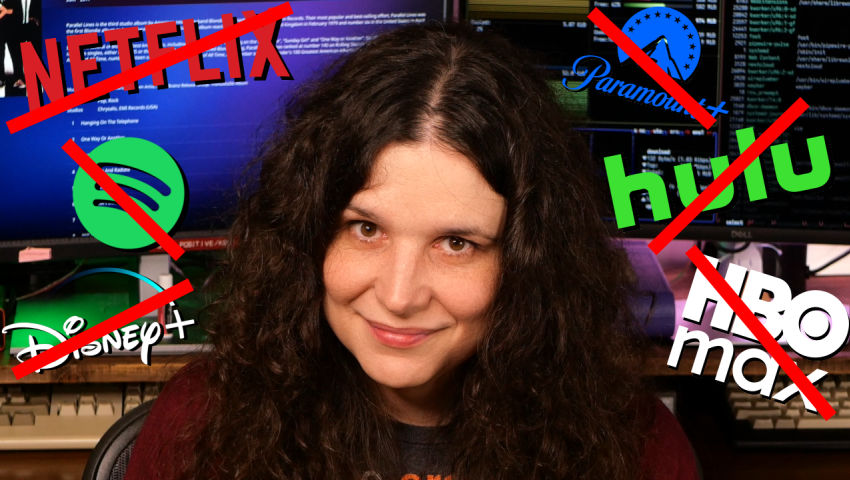
I’m one of those hipsters who doesn’t use streaming services.
I did, a while ago, but I quit using them because the experience is kind of awful, and I’m happier now for it. I collect physical media and watch it using Jellyfin on my Linux-based home theater PC, and I’m completely satisfied with how it works.
I’m making this video because I am really troubled by algorithmic helplessness, and I feel like corporate-centralized streaming media makes that worse. Maybe this video will encourage someone else to cut the cord and rediscover an appreciation for owning your media and being choosy about what to “watch next”. Or maybe I’m just wasting time. Who knows? I suppose, you know, you’re reading this description, right?
If you read the description, say “algorithmic helplessness sucks” in the comments. That’ll make me feel better.
The thing I hated about Netflix was the stress of knowing i was being watched with my viewing habits and that affected how they decided to cancel or continue shows.
Imagine being a customer at a restaurant and the chef is in the back watching you eat, saying things like:
“well, if he doesn’t eat the whole thing in less than 10 minutes that means he probably hated it and won’t continue to buy more burgers, so we should just remove it from the menu now and never serve that burger again.”
Who the fuck wants to ‘relax’ and watch stuff when i know if I start watching something and stop after episode 1 because I liked it, realize my partner might also like it, and I wait 3 months to watch it together (not within their 30 day or whatever window), knowing that might contribute to Netflix canceling a show that I fucking liked in the first place!
SO RELAXING GUYS!
So no, I don’t stream stuff anymore. I’m sick of paying for content that constantly gets canceled, and also experiencing stress while doing so.
Side note, the restaurant analogy is exactly why I hate the seemingly American style of service where the waiter asks how the food is halfway through.
I guess that’s a good analogy for how creepy surveillance capitalism is, it’s like a waiter judging and recording your every move and reaction throughout the entire meal.
So that’s what’s going on! I was wondering why people are doing that everywhere I eat out all of a sudden. Bloody annoying. Me with a mouth full of food having to force out a “yhh shh rlly gwwd tnnk yww”.
Gtfoutahurr
just one of the many negatives of tip culture
I’m not tipping. I refuse to adopt that culture as well. I’ll literally die on that hill. Workers deserve a wage, not to depend on people’s good graces like beggars wiping car windows.
I mean… that IS how restaurants work. If people don’t order the fish of the day then they buy fewer and fewer fishes until it is no longer a thing. Even the speed people eat DOES matter since restaraunts tend to be designed around each customer spending a certain amount of time dining. Too short and they will never order a dessert. Too long and they are costing you money while they nurse that coffee.
And similar happens with even buying blu-rays. If nobody bought Master and Commander in 4k then you can be sure that experiment would be over. Instead? That thing sold like toiler paper during COVID and we’ll likely see more “prestige” releases with a huge dose of FOMO.
As for up fronts versus long tails? Guess what is motivating all those revivals “nobody asked for”?
Don’t get me wrong. I vastly prefer to rip blu rays to my NAS and watch via plex. But the idea that you are somehow no longer part of the marketing cycle is just… wrong.
The only way to stop corporate greed is to stop consuming. Easy to say, hard to do, but not impossible. I’ve lived most of my life striving to be as self sufficient as humanly possible, and that has carried me over into self hosting.
Go hiking, exercise, play sports with your mates. Take up a physical hobby like blacksmithing, electronics even woodworking. Spend the weekends on small projects, DIY drones, a wooden sculpture, a small knife made from recycled corrugated steel. Join a volunteer group, do charity work, help out in the soup kitchen. Nowadays it’s easier than ever to not consume content.
Not the person you’re answering to, but: You say this as if everybody enjoys manual labor, sports and/or outdoor activities. None of the proposed activities elicits the least amount of interest for me, for example.
People should go outside atleast. The sun is bright and beautiful, the skies blue, the beaches are warm and the ocean smells kinda salty.
Some people are out doors all day for work… They may not want their hobbies to reflect their work
And many of those activities include consumption. If you’re doing more than casual hiking, you probably aren’t using second-hand shoes from the thrift store.
More people should try barefoot hiking. I love it, but most people I know, they don’t even try it
Australia’s snake population thanks you for your marketing campaign.
Open source/selfhost projects 100% keep track of how many people star a repo, what MRs are submitted, and even usage/install data. And many of them are specifically designed to fulfill a role that industry standard tools aren’t (or are too expensive for) and… guess where the data on that comes from?
The reality is that you cannot escape consumerism in the modern world. You can pretend you are but… you aren’t. What you CAN do is focus on supporting tools and media that you want/approve of and making your own life better as a result.
And a big chunk of that involves actually thinking through consequences.
I feel it is important to make a distinction here, though:
GitHub, the for-profit, non-FOSS, Microsoft-owned platform keeps track of the ‘stars of a repo’, not the open-source self-host projects themselves. Somebody hosts their repo forge on Codeberg, sr.ht, their own infrastructure or even GitLab? There’s generally very little to no algorithmic number-crunching involved. Same for MR/PRs.
Additionally - from my knowledge - very few fully FOSS programs have extensive usage/install telemetry, and even fewer opt-out versions. Tracking which couldn’t be disabled I’ve essentially never heard of in that space, because every time someone does go in that direction the public reaction is usually very strong (see e.g. Audacity).