I write technical documentation and training materials as part of my job, and the state of most open source documentation makes me want to stab people with an ice pick.
Over my career, it’s sad to see how the technical communications groups are the first to get cut because “developers should document their own code”. No, most can’t. Also, the lack of good documentation leads to churn in other areas. It’s difficult to measure it, but for those in the know, it’s painfully obvious.
Jesus, technical people are some of the worst communicators I’ve ever worked with.
It’s not necessarily their fault though. Y’know who goes into technical jobs? People who often prefer to work with machines, physical stuff, laws of nature, that’s who. And often because it’s MUCH easier than working with people, at least for them.
On top of that, soft skills are HARD. Communication is HARD. It comes easier for some, but it’s a skill like any other. It’s the technical socialites, the diplomatic devs who become the best managers and leaders, due to the rarity of their hybrid skillsets.
I’m in the middle. Just technical enough to mostly understand the devs and understand the implications of plans, and just enough soft skills to turn that into decent documentation, emails, and working with clients.
SUCKS that I’ve gotten a taste of project management and hated the absolute fuck out of it. I probably would’ve been decent at it otherwise.
“Well–well look. I already told you: I deal with the god damn customers so the engineers don’t have to. I have people skills; I am good at dealing with people. Can’t you understand that? What the hell is wrong with you people?”
Do you have any tips for writing professional documentation? I want to do some for my workplace but it’s hard to know where to start, how to arrange it, etc
as a chronic documentation reader, the best advice i can give is to document everything Anything that the user can and will potentially interact with, should be extensively documented, including syntax and behavior. Write it like you’re coming back to the project in 5 years after having done nothing and you want to be able to skip right to using it. When we build something ourselves, we often hold a bit of internal knowledge from the design process that never quite goes away, so it’s almost always a lot easier for us to reverse engineer something we’ve made, than it is for someone else with zero fore-knowledge to do it themselves.
Generally this can be a bit of a nightmare, but if you minimize the user facing segment it’s not all that bad, because it’s usually pretty minimal, and what would otherwise be a handful of pages, turns into 10 or maybe 15.
as for existing documentation, the i3wm user guide is really good, it’s pretty minimalist but it leaves you enough to be able to manage.
Yes. Here: "1.You aren’t writing an SOP for smart or even capable people., every. Single. Person. Needs their hand held all the way through every step regardless of technical skill. "
“2.if you didnt state it needed to be done in the SOP, it will not be done when the end user follows the SOP”
“3.MAKE someone else run through your SOP without you being involved. If they can successfully achieve what they needed using your SOP > congrats. If not > fix the errors that brought you to this mess.”
“4. Everyone is fucking stupid, be clear, and verbose.” We’re talking about where the start menu is, clicking on the “OK” for prompts, how to spell and type things out.
Change my given values per SOP and what it’s for. But those are my main tenants.
In elemental school we had to write instructions on how to make a pb&j sandwich. The teacher then acted out your instructions literally, without adding or removing a step. I don’t think there was a single sandwich made that day.
Excellent notes. If I could add anything it would be on number 4 – just. add. imagery. For the love of your chosen deity, learn the shortcut for a screenshot on your OS. Use it like it’s astro glide and you’re trying to get a Cadillac into a dog house.
The little red circles or arrows you add in your chosen editing software will do more to convey a point than writing a paragraph on how to get to the right menu.


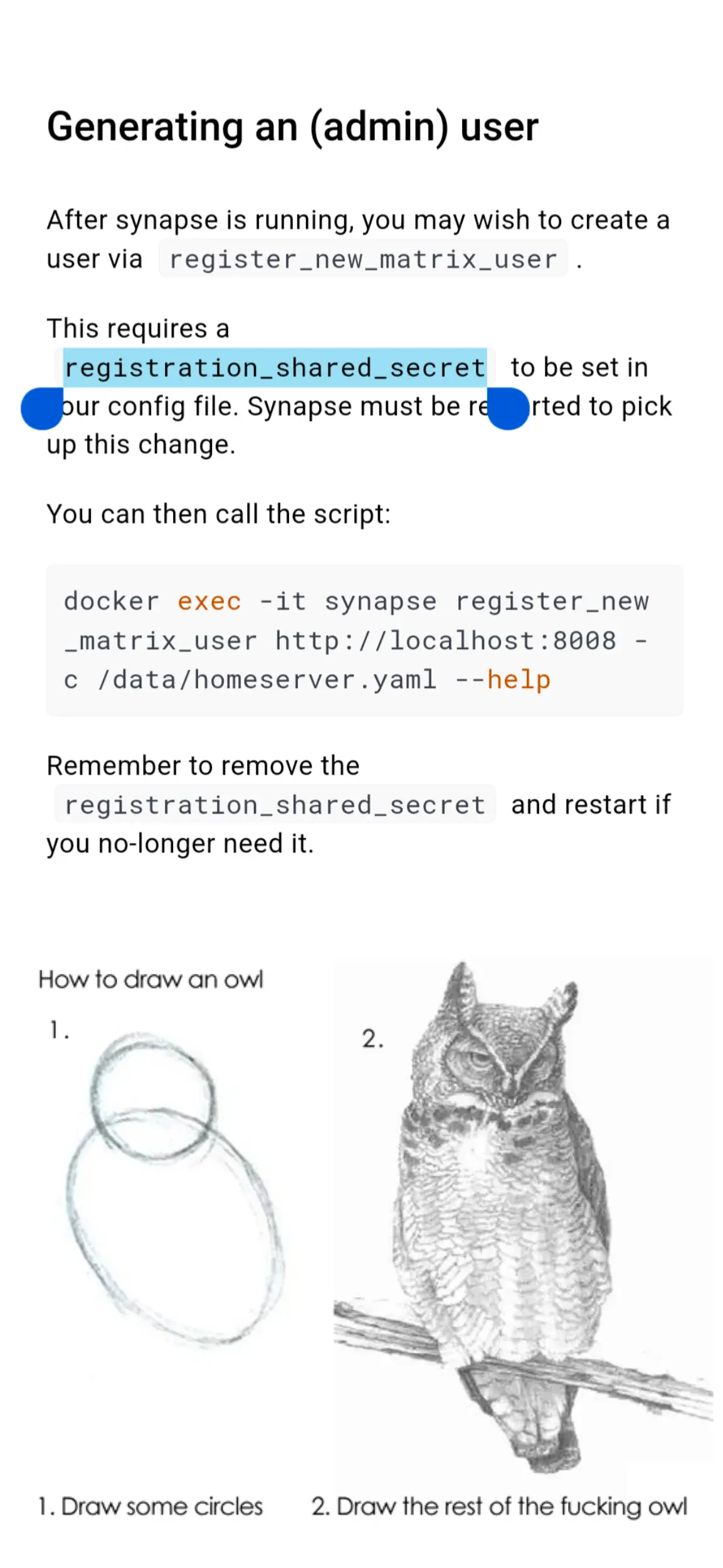
I write technical documentation and training materials as part of my job, and the state of most open source documentation makes me want to stab people with an ice pick.
You’re doing God’s work!
Over my career, it’s sad to see how the technical communications groups are the first to get cut because “developers should document their own code”. No, most can’t. Also, the lack of good documentation leads to churn in other areas. It’s difficult to measure it, but for those in the know, it’s painfully obvious.
Jesus, technical people are some of the worst communicators I’ve ever worked with.
It’s not necessarily their fault though. Y’know who goes into technical jobs? People who often prefer to work with machines, physical stuff, laws of nature, that’s who. And often because it’s MUCH easier than working with people, at least for them.
On top of that, soft skills are HARD. Communication is HARD. It comes easier for some, but it’s a skill like any other. It’s the technical socialites, the diplomatic devs who become the best managers and leaders, due to the rarity of their hybrid skillsets.
I’m in the middle. Just technical enough to mostly understand the devs and understand the implications of plans, and just enough soft skills to turn that into decent documentation, emails, and working with clients.
SUCKS that I’ve gotten a taste of project management and hated the absolute fuck out of it. I probably would’ve been decent at it otherwise.
“Well–well look. I already told you: I deal with the god damn customers so the engineers don’t have to. I have people skills; I am good at dealing with people. Can’t you understand that? What the hell is wrong with you people?”
Do you have any tips for writing professional documentation? I want to do some for my workplace but it’s hard to know where to start, how to arrange it, etc
Do you have some reading recommendations on how to write good documentation, e.g. readmes for end users?
as a chronic documentation reader, the best advice i can give is to document everything Anything that the user can and will potentially interact with, should be extensively documented, including syntax and behavior. Write it like you’re coming back to the project in 5 years after having done nothing and you want to be able to skip right to using it. When we build something ourselves, we often hold a bit of internal knowledge from the design process that never quite goes away, so it’s almost always a lot easier for us to reverse engineer something we’ve made, than it is for someone else with zero fore-knowledge to do it themselves.
Generally this can be a bit of a nightmare, but if you minimize the user facing segment it’s not all that bad, because it’s usually pretty minimal, and what would otherwise be a handful of pages, turns into 10 or maybe 15.
as for existing documentation, the i3wm user guide is really good, it’s pretty minimalist but it leaves you enough to be able to manage.
Yes. Here: "1.You aren’t writing an SOP for smart or even capable people., every. Single. Person. Needs their hand held all the way through every step regardless of technical skill. "
“2.if you didnt state it needed to be done in the SOP, it will not be done when the end user follows the SOP”
“3.MAKE someone else run through your SOP without you being involved. If they can successfully achieve what they needed using your SOP > congrats. If not > fix the errors that brought you to this mess.”
“4. Everyone is fucking stupid, be clear, and verbose.” We’re talking about where the start menu is, clicking on the “OK” for prompts, how to spell and type things out.
Change my given values per SOP and what it’s for. But those are my main tenants.
In elemental school we had to write instructions on how to make a pb&j sandwich. The teacher then acted out your instructions literally, without adding or removing a step. I don’t think there was a single sandwich made that day.
Excellent notes. If I could add anything it would be on number 4 – just. add. imagery. For the love of your chosen deity, learn the shortcut for a screenshot on your OS. Use it like it’s astro glide and you’re trying to get a Cadillac into a dog house.
The little red circles or arrows you add in your chosen editing software will do more to convey a point than writing a paragraph on how to get to the right menu.
Absolutely! But I use markdown / Obsidian for my SOPs so images are kinda obnoxious to format. But yes!